Free field tool

Quantify the deal. Defend your price. Close on ROI.

Price objections are value you never put a number on. The Value-Selling Cheat Sheet is a one-page field tool: the discovery questions, the value map, and the formulas that turn a deal into a number the CFO can defend. Enter your email and it lands in your inbox.

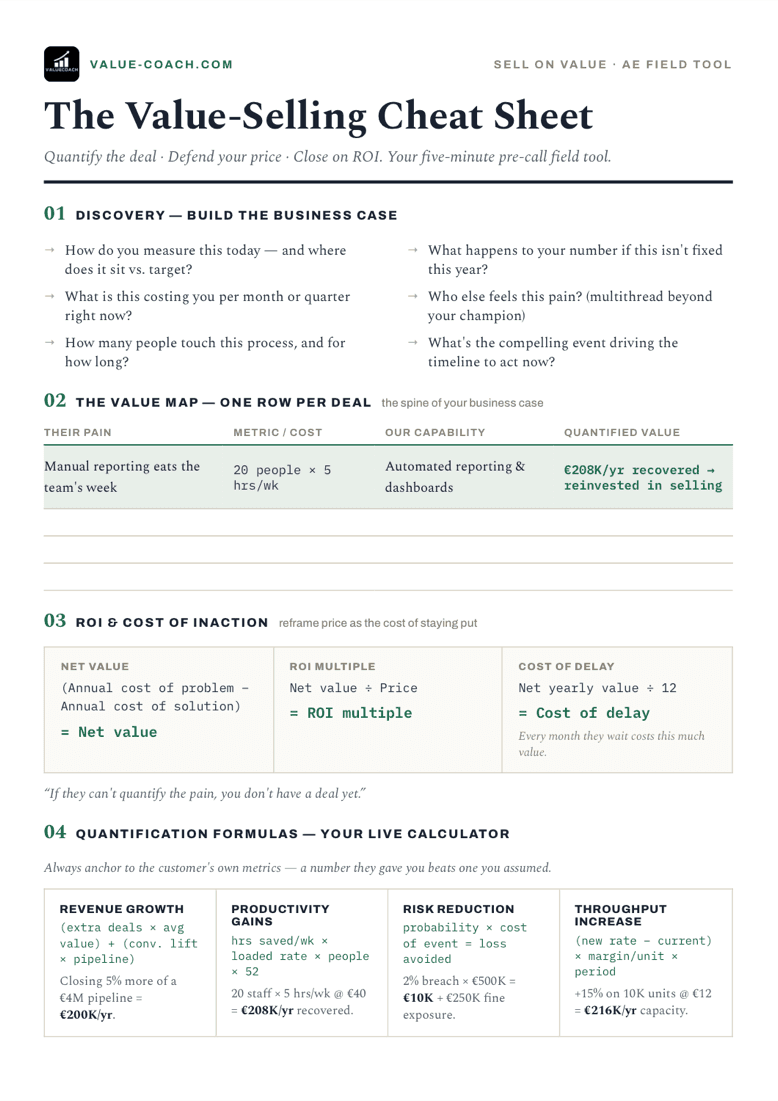
The Value-Selling Cheat Sheet: a one-page field tool with discovery questions, a value map with their pain, metric, capability and quantified value, ROI and cost-of-delay formulas, and four quantification formulas for revenue, productivity, risk and throughput.

Get the one-page cheat sheet

The discovery questions, the value map, and the quantification formulas, already laid out. Free.

No spam. Unsubscribe in one click.

Four parts. One page.

Discovery sizes the problem. The value map turns it into a case. The ROI math reframes the price. The formulas put a defensible number on every claim.

🔍

1. Discovery that builds the case

Six questions that size the problem before you pitch: what it costs per quarter, how many people it touches, what happens to their number if it is not fixed, and the compelling event driving the timeline. You leave with a figure to work from, not a hunch.

🗺️

2. The value map

One row per deal, four columns: their pain, the metric or cost behind it, the capability you bring, and the quantified value it creates. The spine of the business case. Every capability maps to a cost, or it does not belong.

📉

3. ROI and cost of inaction

Net value, ROI multiple, and the cost of delay on one line each. Net yearly value divided by twelve is what every month of waiting costs them, which is the number that moves a timeline from next quarter to now.

🧮

4. Quantification formulas

Revenue growth, productivity gains, risk reduction, throughput. Four buckets, each with a formula you run live on the customer's own inputs, so the number is theirs to defend and not yours to argue.
If they cannot quantify the pain, you do not have a deal yet.

"Too expensive" is almost never about price. It is about a value the buyer cannot measure and cannot defend to their own finance team. The cheat sheet forces the number out early, from the customer's own metrics, so the business case stops being your pitch and becomes their math. That is the only math a CFO trusts.

About the cheat sheet

What is in the cheat sheet?

One page, four parts: the discovery questions that size the problem, the value map that turns pain into a quantified business case, the ROI and cost-of-delay math, and four quantification formulas (revenue growth, productivity, risk reduction, throughput) with worked examples. It is built to sit next to you on a call.

Who is it for?

Account executives and sellers running enterprise deals where price gets questioned and finance has the final say. If you have ever lost a deal to "too expensive" or "no decision," the cheat sheet is for the conversation before that happens.

How do I use it on a live deal?

As a five-minute pre-call tool. Run the discovery questions to get the numbers, drop them into the value map, then use the formulas to turn the pain into net value, an ROI multiple, and a monthly cost of delay. Anchor every figure to a number the customer gave you.

Related resources

Article

How to Quantify Value in a Sales Deal

Tool

The Value Story Canvas

Template

The 5-Slide CFO Business Case Template

Book the free "Sell to the CFO" workshop

90 minutes. Your team. A business case framework they'll actually use.